24.07.2012

23.07.2012
Chapter VI: Scipio ante Portas
„Hannibal is what Carthago needs in these days; a man who doesn’t fear the enemy, who knows Rome is mortal and who has the courage to try the impossible. Oh my Hannibal where are you?.“ – Gildo
Ortygia is
the cradle of Siracusae. Gainas would like to rename the small island off the
coast of Sicilia, give her a title that suits her more, now that the Vandals
rule here. The people should know from the name alone that not Romans or Greeks
are in control of island and city but Vandals. Maybe: Gainasia, Gainopolis; no,
he is not King, that’s not appropriated. Godigisela, or –um, or maybe
Godigiselopolis; no, to long and this bastard is not worth having a city named
in his honour. Vandalia?
For now
Gainas has to think about other thinks, than names, more important things.
Alaric and Honorius ordered ships. A whole fleet they want, where is he
supposed to get so many ships from, maybe from the harbour right next to him? Yes, there are ships, many of them and they
actually belong to the Empire but why should he give them back? He conquered
the island with them, in Honorius’ name, but he never gave the island back. How
can he now trust the emperor, Gainas stole from him and defraud him of his
island, why shouldn’t he seeks revenge, why shouldn’t he betray him? No ship
will leave this island towards Africa to defeat the Tyrant of Carthago, at
least not without loyal Vandals. If the Usurper should fall than he should fall
through German hands.
What has
Honorius without Gainas? Nothing! An empire, he doesn’t control but Alaric,
provinces in rebellion and nearly no ships to beat them down. With some bad
luck Africa could even fall to Arcadius, if the East feels like grabbing for
it. What is Gainas without Honorius; a dubious ally, maybe a pirate, a
potential target for Constantinople or an independent ruler by everything but
name? And with Honorius? Maybe he will be the ruler of Africa or maybe nothing
but a piece in the great game for Rome. For now it seems the emperor needs Gainas
more than the other way around, that means he will get his ships, but not
without Vandals. Carthago will fall.
The gates
of Carthago, which are now broken, still show how Gildo tried to protect his
city - with elephants. Not real ones, but with blood painted, big eared and
long nosed animals, guard the gates. Their red bodies are flat and made out of
the blood of prisoners, which were taken out of their cells, lost their heads –
which were used as terrifying warnings for the Vandals – and were robbed of
their blood. But his elephant army couldn’t save Gildo, neither could his human
one. The Tyrant of Africa is dead and his palace is conquered. Vandalia would
also sound good for this city. But again Gainas has better things to do than
thinking of names. Today he will show mercy with four of his prisoners, because
the emperor asked for it and he feels like granting him this wish – actually
it’s a command but what does he care for Honorius’ commands.
Nearly he
would have killed him, killed this ungrateful bastard. What does he think he
is, his life depended on him but he was stupid enough to open his mouth and
accuse him of murder, what right does he believes he has? Murderer! He did not
even touch his father, let alone killing him. Gainas even liked him more or
less. But in the end it was his, Stilicho’s, decision to stay with Honorius.
They could have marched together at Mediolanum or Constantinople. Not he killed
Stilicho, but his own stupidity. How dare Eucherius to call him a murderer ever
again. At Narona a potential ally died in Gainas’ eyes, but not an enemy.
Eucherius, his mother and his sisters can go away from this place, far away, to
a place which was chosen by the court in Arelate. Their new home would be a
small but nice mansion near Burdigala, close to the Goths and the Atlantic, far
away from the centre of the empire and even farer away from Gainas, who would
kill this brat if he would come close to him ever again.
Gildo was
dead, Mallius Theodorus not yet and that made him the reason for Gainas to send
his troops to the west, to Mauretania, to find the Usurper and to expand his
influence. Many inhabitants of Mauretania are Arian Christians, which is a fact
that could help Gainas to secure control over his territory; he is an Arian
himself, while the emperors are Trinitarians. Vandals and Moors could be the
base of Gainas’ rule, but for now the later ones are not yet under his control.
Mallius has to be defeated once and for all and Gainas has to do it if he wants
control over all of Africa.
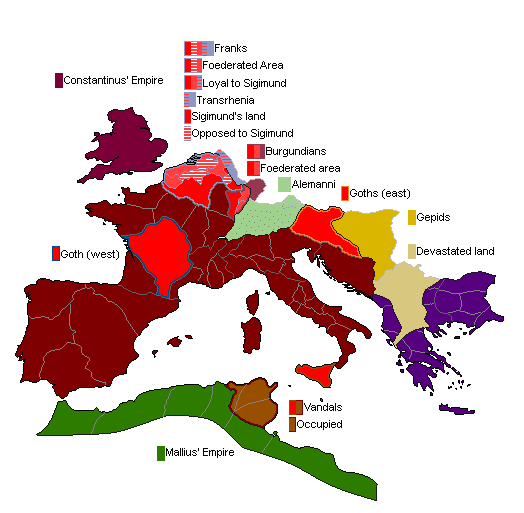
Map
The Western and parts of the Eastern Roman Empire in 407 AD.
Red=Western Empire; Light Red=Goth; Striped=other foederati; Brown=Vandals
Purple=Eastern EmpireGreen=Mallius Theodorus' Empire
Magenta=Britannian Empire
Yellow=Gepids
17.07.2012
Chapter V: Pannonia
„Over me are only the gods.“ – Thorigais
Uldin, King
of the Huns - not all of them, but the most – is facing his nightmare. The
Empire he built up in the last years could collapse if he loses this battle.
The Hun King looks terrifying; his face is full of scares, his head bald and
deformed. The Romans fear him, they know why so many tribes cross their borders
and they know the Huns are the reason for all this, but not Roman troops will
challenge Uldin, not a single army dared to cross the Danubius, today he will
fight his own fellows.
Thorigais,
Leader of the Eastern Goths – and some other tribes – is young, ambitious and
hates the Huns. He was born as his people were already enslaved by them, he never
saw the Kingdom of Ermanaric but he knows that the Goth won’t stay forever
under the Hunnic rule. The young man enjoyed the Hun King’s trust, always did
Thorigais anything to please Uldin, he fought his battles, even striked down
the Gothic rebellion of Radagais. As the King led an army into the devastated
Pannonia in 401 AD, which was left by Roman armies and Vandalian settlers,
Radagais followed him dutiful, but as Uldin left to smash a rebellion in the
south east, he gave the command over the Pannonian troops to his cousin.
Radagais used the weakness of his new lord to shake of the Hunnic yoke. Before
Uldin even could arrive in Dacia and beat down the revolt, his cousin’s head
already reached him.
While the
Hun King destroyed all resistance against him in Dacia, Thorigais used the time
to build up his own army. He gathered the Germanic tribes around him that lived
under the Hunnic rule and formed a confederation against Uldin. Even the
Siligian Vasals, who were on their way to the south to enter the Imperium,
joined Thorigais.
It was a
cold and windy day on which Uldin attacked. The cloud of arrows that was
supposed to smash Thorigais’ troops was stopped by the clouds of the sky, which
turned the once dry ground into a field of mud. Lightings, like a divine omen,
stroke into the trees behind the Hunnic troops. This day would be known as the
Battle of the Storms. The Hunnic rule was broken on this day, only for now and
only in Pannonia, but Uldin was dead and his troops defeated, Thorigais ruler
of Pannonia. Soon a letter from Honorius would arrive at his residence in
Savaria and an answer would follow immediately:
“Oh Augustus, you are demanding tribute, you
demand that I obey your rule!? [..] You don’t rule over this land, not even
over your own. Do you believe I know nothing about your Empire? […] Who shall
help you, helpless little Augustus? The Goths of Gallia? They don’t save you,
they rule over you! The Vandals of Italia? They don’t save you, they hate you!
[…] You are not my lord, there is no one ruling me; over me are only the gods!”
Thorigais
was right about what he said. Only a few months later the Vandals, under Gainas
command, conquered the rebellious city of Rome. Over the next year Gainas and
Godigisel stayed near Rome in Portus before they left the mainland to conquer
Sicilia. In Gallia Alaric was finally able to force a peace with the Franks in
the summer of 405. The land in which the Goths and Vandals should settle was
secured, but Gainas refused to leave Sicilia again. Honorius was forced to
grant the Vandals the islands.
Thorigais
was right about the instability of Rome, but he overestimated his power. After
the Huns were beaten, the confederated tribes split. The Gepids overthrew
Thorigais, his Empire fell, his Goths marched to the south and joint Honorius
as foederati. The Gepids stayed in Pannonia, whereas a third group of mixed
heritage, on the search for land and wealth, moves to the east.
Map
The Western and parts of the Eastern Roman Empire in 405 AD.
Red=Western Empire; Light Red=Goth; Striped=other foederati; Outline=Vandalian Sicily
Purple=Eastern EmpireGreen=Mallius Theodorus' Empire
Magenta=Britannian Empire
Yellow=Gepids

Chapter IV: Alaric and Honorius
„The Empire’s enemies are mine; I will hunt, find and destroy them.“ – Alaric
The treaty
of Bononia, Christmas 401 AD, changed everything in the war for Rome: One month
earlier Alaric’s troops defeated Saturninus’ army in the Battle of Verona and
captured the Magister Militum. Honorius, now for sure in an awful situation,
had several options: allying with Mallius in Gallia, who would claim at least a
part of the Empire for himself, maybe even everything; allying with Gildo, who
is on the other hand totally unpredictable and no one knows what he is really
fighting for - the magister militum position, emperorship, independence,
revenge, nobody can tell - ; or allying with Alaric, who showed to be a
talented but very ambitious general and would demand land for his soldiers.
In the end
Honorius decide to ally with Alaric and to agree on his demands: the King would
become Magister Militum, the Goths would be settled between Ligara and Garunna
(mostly the provinces Aquitania I and II), the Hasdingi would settle north of
them around Lutetia and Senones. In exchange for this Alaric would march
against Mallius and Gildo.
Godigisel
and Gainas began in the name of Honorius’ their campaign against Gildo’s troops
in Italia. Even if they now fought for the Empire, so were they nevertheless
plundering all the way to the south and camped symbolically near the city of
Rome to provoke the Romans and to remind them, who is now in power. At Easter
402 AD, while waiting for the African troops to challenge the Hasdingi in an
open battle, Gainas and some of his soldiers entered the Rome to celebrate the
Holy (Arian) Mass in Rome. That was the last straw to convince the population
and the senate, that these barbarians were not only scornful and disrespectful
but a threat for the Empire, its culture and tradition. After Gainas left the
city again and the Hasdingi moved further to the south east in the hope to be
able to challenge the Africans there, the Senate decided to side with Honorius’
enemies.
In the
meantime, Alaric marched into Gallia and Mallius flew to the south into
Hispania. The Goth king took Vienna without battle, secured the Pyrenees passes
and decided to move to the north and destroy the Germanic military backbone of
Mallius, namely Sigiric’s troops, before turning to the south to finally end
the usurpation.
Honorius’
decision to trust in Alaric as an ally affected all participants of the war.
Arcadius lost control over his young brother and East and West can now not
anymore trust on each other’s help in the future. Hasding King Godigisel blames
Gainas for the loss of Rome to Gildo and cracks show between both; Gainas
builds the young Geiserich up to be next king, while Godigisel prefers his
older son Gunderic. Gainas made himself unpopular with the Hasding leader but
the soldiers seem to favour him more than their own king; Godigisel sinks into
powerlessness, whereas Gainas becomes the real ruler. In Hispania Mallius meets
with one of Gildo’s legates; who informs him that Africa is now on his side.
Britannia breaks away from the Empire as Alaric demands - in a very rude manner
-that their troops should fight in Gallia. The island is now ruled by Emperor/Usurper
Constantinus, who prefers to stay their instead of fighting on the tumultuous
mainland. Lacking the Britannian troops Alaric is unable to decide the war in
Gallia in his favour but has to fight a long and exhausting campaign against
Sigiric. The remaining Italian forces couldn’t stop parts of the Alemannians to
break through the Alpine passes and plunder several cities. Honorius relocated
the court to the freshly conquered but far saver Arelate. Here on the bank of
the Rhodanus, the Emperor can do nothing but wait for Alaric to win or to fall
and he would follow him.
Map
The Western and parts of the Eastern Roman Empire in 403 AD.
Red=Western Empire; Light Red Outline=Planned Gothland
Purple=Eastern EmpireGreen=Mallius Theodorus' Empire; Light Green-Striped=Sigiric's army
Magenta=Britannian Empire

13.07.2012
Chapter III: Gallia
„Gallia: land
of the barbarians and tyrants. “ – Symmachus I.

Mallius
Theodorus, who feels still odd when called Augustus and who did not really
wanted this office, is only in that position because he is not made for being
Emperor, he is no General, no military talent; he is a philosopher, a well-known
writer, not a ruler.
How did it
come that he is now Augustus? As the Germans crossed the Rhine in the year 399
AD Mallius Theodorus was in Treverorum, administrating the land between
Gibraltar, Rhine and Atlantic, in the name of Emperor Honorius. The Magister Militum,
unable to defend the north of Gallia, withdrew to the south but Mallius stayed in
Treverorum. Four weeks later Frankish and Burgundian troops conquered the city
and captured him. He stayed a prisoner, for several months, until the leaders
of the Germans, especially Sigiric a Frankish king, became impatient with the
Emperor in Italia, who was neither willing to grant them land nor positions in
the Imperium. Sigiric gave Mallius his freedom back and made him with the other
tribes’ support Emperor – or Usurper – in exchange for the foederati status and
military positions.
The Franks
in the north of Gallia expanded their territory to the east and south and
Sigiric, the mightiest of their kings and now Comes of the Imperium, claims the
military command over all the northern provinces and is able to full fill this
ambition at least between the channel and the Mosella. The Alemanians settle between
Danubius and the Alps, securing the northern Alpine passes for Mallius. A part
of the Burgundians controls the area between both, whereas another part
continues to plunder Gallia; together with Alans and the Silingi-Vandals.
After granting
and defining the tribes’ territory, Mallius moves with all avaible troops to
the south, away from Treverorum, where now Sigiric likes to resides, and the foederati
controlled north towards the south, the city of Vienna, which is closer to the
Empire’s heartland, Italia. Militarily incompetent Mallius and his more
competent generals and backers hope, that the various factions in the war over
the Imperium will weaken each other so much, that they can take the rest of the
Empire without problems. In the moment the Gallian tactic seems to work,
because Honorius’ army is battling Alaric, who crossed the Alps, on the
Adriatic coast and Gildo’s troops in the south, which were lucky enough to take
Sicilly nearly without casualties and are now advancing into Italia and
Hispania. A negative aspect for Mallius is that he has a chronic troop shortage
and would be barely able to hold the southern alpine passes; worst of all
Britannia is holding to Honorius or better to everyone who won’t take the
island’s troops right now. Southern Gallia may be the safest place to be in the
Western Empire, for men because they don’t have to fight, just to wait, and for
women and children because the Barbarians are plundering and burning down the
north; but that can all change in a matter of weeks, maybe only days. It could
be the silence before the storm for Gallia.
Blue=Alaric's troops
Gold=Area controlled by Gildo
Green=Mallius Theodorus' Empire; Light Green-Striped=Foederated Peoples and influence
Map
The Western and parts of the Eastern Roman Empire in 401 AD.
Red=Western Empire
Purple=Eastern EmpireBlue=Alaric's troops
Gold=Area controlled by Gildo
Green=Mallius Theodorus' Empire; Light Green-Striped=Foederated Peoples and influence
09.07.2012
Chapter II: Gainas and Eucherius
„Oh, dear
cousin, your father is dead, so is mine, but you don’t see me crying over that.
We all have to depart this life one day or another. Crying doesn’t bring him
back, better wipe of your tears; you will need your eyes in these days more
than ever before. “ - Honorius

Mediolanum
is the crown jewel of the West, seat of the Emperor, magnificent centre of the
Roman world. At least centre of Honorius’ part, a shrinking part; the Emperor
is young and weak and his enemies know that. Dalmatia, the bloody, rural and
devastated opposite of the capital, is lost for the West. Troops conquered it
in the name of Arcadius and the Eastern Empire and now a barbarian is sitting
on the throne of Diocletian, Alaric king of the Goths, foederati of the East.
While Arcadius is sending one of his advisors to rule for his younger brother.
Stilicho’s
blood wasn’t even dry yet but the Illyricum already partitioned. Alaric, now
ruler of Dalmatia and the western part of Dacia, granted Gainas the rule over
the land between Dravus and Savus – minus the area around Sirmium – and the
province of Moesia. Siscia was chosen as Gainas residence. The cities location
is symbol of his ambitions, on the bank of the Savus, far away from the save lands
of Moesia, on the border to Honorius’ Pannonia, ready to be the centre of a new
independent kingdom. North of Gainas realm the Hasdings live, Vandals, unable
to resist the pressure of the Huns, which move slow but steady in their
direction. They could be the backbone of his dreams, of his Empire.
The death
of Stilicho may be the dream of some people, of his enemies, of Gainas, of the Senators
but it was the start of a nightmare for Eucherius, his son. His father’s
supporters saw the young boy as a Roman, his father’s enemies as a Barbarian. He
and his mother, Serena, a cousin of Honorius, are seen as enemies of the Empire,
his death father seen as a betrayer, who wasn’t able or willing to destroy the
Goths. 2 1/2 months after Stilicho’s death the child, his mother and his
sisters flew from Mediolanum, shortly before Arcadius’ advisor Saturninus arrived
to rule the West as the new regent for the young Emperor Honorius. Saturninus,
supported by the anti-Gothic groups in the Empire, begins to concentrate troops
in northern Italia expecting King Alaric or his Dux Gainas to invade Pannonia
or the plain of the Padus in the near future. Planning to defeat the Goths in one
final battle and to destroy the potential thread of the Empire, he neglects the
limes and loses the focus on the border provinces, which are threatened by the
Germanic tribes.
In Carthago
Gildo, a general of Moorish origin, rules, controlling Roman Africa and not
being known for being very loyal but very selfish and opportunistic. As
Eucherius arrives at his palace in Carthago, he grants him exile and swears
revenge for the disrespectful treatment of his family. Africa, the bread basket
of the Empire, breaks away, so does the Rhine border a few weeks later, while
Pannnonia sinks into anarchy. The remnants of Stilicho’s army are plundering northern
Dalmatia and southern Pannonia since the death of their general, led by a Roman
named Flavius Maximinianus. After a skirmish
between them and the Hasdings, Hasding-King Godigisel agrees to ally with
Gainas against Maximinianus’ troops. Saturninus, misinterpreting the Gothic
troop movement, leads the half of his army to Pannonia, while the rest prepares
to sail to Africa. Noticing the Roman troop movement Alaric decides to finally
break with Arcadius, because Saturninus’ troops are marching against the Goth
and that not only for Honorius’ interests but also for Arcadius’. The end of
the Goth-King would be favourable for both brothers. If Alaric wins this war it
could mean the end of the Theodosian Dynasty, atleast in the West.
Map
The Western and parts of the Eastern Roman Empire in 399 AD.
Red=Western Empire; Lighter Shade=Foederated Franks and their influence
Purple=Eastern Empire
Blue=Empire of Alaric; Lighter Shade=Gainas/Hasdingi
Gold=Area controlled by Gildo
also showing the Germanic tribes on that crossed the Rhine
08.07.2012
Chapter I: The battle of Narona
AD 397:
„I trusted
you, you betrayed me; today I trust you that you will die, today you won’t
betray me.“ - Stilicho
The wind
comes from the west, from the sea, it’s cold and salty. Flavius Stilicho is
walking nervously trough the rows of soldiers, while speaking to his
confidants. Mistrust is Stilicho’s loyal fellow and most trusted advisor in the
last months; today more than ever before.
Last night
he woke up covered in sweat, it was a nightmare; for him a prophecy. Stilicho
believed to see his own destiny; he witnessed his own death. Honorius, Emperor
of the west, would strangle him to death. The boy betrayed him; Stilicho
secured the child’s throne, he smashed his enemies and were loyal his whole
life, loyal to Honorius’, his father, the Empire and would have served even
under Honorius’ sons, but this infant laid the hands around his general’s neck
and slowly took his breath until Stilicho woke up, struggling for air.
The general
trusted no one; he couldn’t trust the Senate because they hated him, the pagan
Senators because he was Christian, the rest because his father was a Barbarian
and because the old Roman aristocracy could not accept the nearly unlimited
influence Stilicho had on the child-emperor. Rumours doubting his own loyalty
to Rome spread in the Empire and under his Roman troops, even if they never
mistrusted their general, so did they however notice how he spent hours alone
in his tent, walking up and down, talking to himself, but no one could
understand what he was saying, not even about the language they were sure –
maybe Latin, maybe German. He even mistrusted his own life guard and distanced
himself increasingly from his own troops.
And all
this mistrust caused by a single man. Two years ago Gainas led a part of
Stilicho’s troops to Constantinople to kill the general’s enemy Rufinus, the
advisor of child-emperor Arcadius, brother of Honorius. But Rufinus was
informed of Stilicho’s plans and challenged Gainas with his own loyal troops
near the city. Nevertheless Gainas troops, mostly Goths, were victorious and
Rufinus flew to the south west. Gainas stayed in Constantinople and got to feel
the mistrust of parts of the Trinitarian aristocracy and the population of the
city, towards the Arian-Germanic troops from the west. In the winter of 396
Gainas left the city following the order of Stilicho to attack the troops of
the Goth king Alaric, which were plundering the Prefecture of Illyricum and
granted Rufinus exile, in exchange of the promise of some high position for
Alaric if he should get back in power.
But Gainas
changed his mind during his stay in Constantinople. He didn’t care for Rufinus
fate anymore nor for Stilicho’s orders, he turned against the Romans and his
commander; instead of fighting Alaric, he and his soldiers joined his army.
From now on Gainas would fight for his own wellbeing instead of Rome’s.
Stilicho would never forget Gainas’ betrayal on him and the Empire.
Arcadius,
feared by the Gothic army in his territory, makes Alaric concessions, giving
him several provinces to govern and settle, so the Province of Dalmatia, which is
contested between West and East.
One year
later Stilicho would meet the Goths at Narona, to break the power of King Alaric,
to conquer Dalmatia and to kill the betrayer Gainas; but in the end he would be the
one to find death.
Map
The Western and parts of the Eastern Roman Empire in 397 AD after the Battle of Narona.
Red=Western Empire; Lighter Shade=Foederati
Purple=Eastern Empire; Lighter Shade=Land of the Goths; Lightest Shade=Land of Gainas

Abonnieren
Posts (Atom)